The photograph had been sitting inside an old wooden drawer for decades.
It wasn’t framed.
It wasn’t labeled.
It was simply tucked between faded postcards and yellowed newspaper clippings that belonged to my grandparents.
One rainy afternoon, while sorting through their belongings, I almost threw it into a pile of ordinary family pictures.
Something stopped me.
The image looked completely normal.
A family gathering.
Several generations standing in front of a small farmhouse.
Children smiling.
Adults chatting.
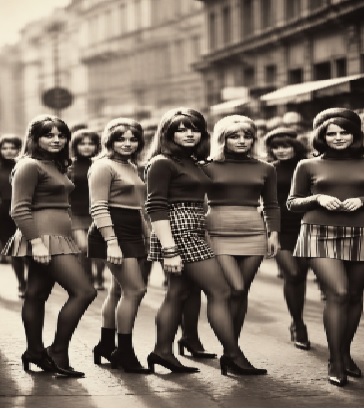
A bright summer afternoon frozen in time.
On the back of the photograph, only three handwritten words appeared:
«July, 1976.»
Nothing more.
No names.
No location.
Later that evening, I decided to scan the picture so I could restore it digitally.
As the image filled my computer screen, I slowly zoomed in, hoping to sharpen the faded faces.
That’s when I noticed something I hadn’t seen before.
One person wasn’t looking at the camera.
Everyone else smiled directly toward the photographer.
But an elderly woman standing near the porch seemed to be staring at something hidden beyond the edge of the frame.
Her expression wasn’t joyful.
It looked almost… concerned.
Curious, I enlarged the image again.
Then another strange detail appeared.
Every person in the yard stood naturally.
Except for one young boy.
His feet seemed to point in one direction while the rest of his body faced another, creating an awkward position that looked almost impossible.
At first I blamed the poor quality of the old print.
Maybe the paper had warped.
Maybe the scanner distorted the image.
To be certain, I contacted a friend who specializes in restoring vintage photographs.
He studied the file for nearly twenty minutes.
Finally he said,
«I can’t find any signs that the image was altered.»
He explained that old cameras sometimes produced unusual distortions, especially around the edges of the frame.
Still…
He admitted that several details didn’t make much sense.
We kept searching.
The more we examined the photograph, the stranger it became.
A curtain inside the house appeared to be moving, even though every tree outside stood perfectly still.
One window reflected blue sky while another reflected dark clouds.
The family dog stared toward an empty corner of the yard instead of looking at the people gathered together.
None of it proved anything.
Yet none of it felt entirely ordinary.
Wanting answers, I showed the photograph to my relatives.
Surprisingly, every person remembered that summer gathering.
But nobody remembered it the same way.
One uncle insisted dozens of neighbors had attended.
My aunt was certain only close family members were present.
Someone claimed the celebration lasted until midnight.
Another insisted everyone left before sunset.
The stories simply refused to match.
A week later, I visited an elderly man who had owned a photography studio since the early 1970s.
He carefully examined the print beneath a bright lamp.
After several minutes, he nodded thoughtfully.
«Old film often surprises people,» he explained.
«Light leaks, reflections, accidental double exposures, even tiny imperfections during development can create details that seem impossible years later.»
His explanation sounded reasonable.
Then he quietly added,
«But there are one or two things here I still can’t explain.»
His words stayed with me.
Out of curiosity, I uploaded the photograph to an online forum dedicated to historical photography.
Within hours, thousands of people had begun analyzing every corner of the image.
Some pointed to the elderly woman’s unusual gaze.
Others focused on the strange position of the boy’s feet.
Several believed they saw another face reflected in the farmhouse window.
The discussions continued for weeks.
No two people agreed on what the real mystery was.
Then something unexpected happened.
A woman contacted me from another state.
She believed one of the people in the photograph was her grandfather.
She attached a nearly identical photograph from her own family album.
The same house.
The same afternoon.
The same people.
But one detail immediately stood out.
The elderly woman wasn’t there.
Instead, a middle-aged man occupied exactly the same place.
Both photographs carried the same handwritten date.
Neither showed any evidence of editing.
Neither seemed fake.
Even today, I don’t know which version captured what truly happened.
Maybe both are genuine.
Maybe neither tells the complete story.
Old photographs have a strange way of preserving more than memories.
Sometimes they preserve questions that remain unanswered for generations.
Take one more careful look.
Can you spot the detail that caught everyone’s attention?
Or did you notice something even stranger that everyone else missed?