She never expected anything in return.
No money.
No compliments.
No applause.
Just a smile… maybe a warm hug if she was lucky.
To Diane, every quilt, pillow, and handmade toy was more than fabric and thread. Each one carried a piece of her heart, sewn together with patience, love, and countless quiet evenings.
After everyone else had gone to bed, she often remained in her sewing room with only a small lamp lighting the table. More than once, she spent hours redoing a single section because it wasn’t exactly the way she imagined it.
I’d tease her.
«The kids won’t notice that tiny detail.»
She always smiled and answered,
«Maybe not… but I’ll know.»
That was simply how she showed her love.
When our first grandson was born, Diane made him a beautiful patchwork quilt decorated with little forest animals and stitched his name into one corner. From that day on, every grandchild received something handmade just for them.
One loved whales.
Another was fascinated by airplanes.
The youngest couldn’t stop talking about race cars.
Diane remembered everything.
Favorite colors.
Favorite animals.
Favorite dreams.
We truly believed those gifts would stay in our family forever.
Then an ordinary Saturday afternoon changed everything.
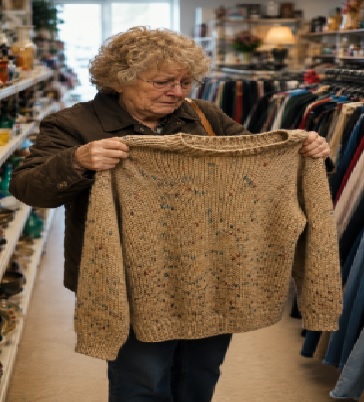
We had gone to a community thrift store to donate several boxes of old books and kitchen items. While I unloaded the donations, Diane wandered toward the section with blankets and home décor.
She suddenly stopped.
Without saying a word, she reached for a folded quilt.
The moment I saw it, I knew exactly what it was.
Inside one corner was a tiny leaf-shaped patch she’d sewn years earlier after accidentally catching the fabric with a pair of scissors.
There was no mistake.
It was the quilt she’d made for our oldest grandson.
Next to it sat a handmade pillow embroidered with a little bear.
Then another quilt.
Then a soft elephant she’d sewn completely by hand.
Within just a few minutes, we found four of her handmade gifts.
Each one had a small price sticker attached.
Each one was selling for only a few dollars.
Diane quietly bought every item.
She didn’t complain.
She didn’t blame anyone.
But she barely spoke during the drive home.
That evening I found her sitting alone in her sewing room.
The sewing machine was covered.
The shelves of fabric remained untouched.
She looked at me and quietly said,
«Maybe I should stop making these things. Maybe they never mattered as much as I thought.»
Those words hurt more than discovering the gifts.
Not because they had ended up in a thrift store.
But because, for the first time in decades, she had lost the happiness that came from creating something with her own hands.
I refused to let that feeling remain.
A few weeks later, our family gathered for our annual holiday dinner.
Before everyone arrived, I carefully placed every recovered gift across the dining room table.
Beside each one, I laid an old photograph showing the exact moment that gift had been opened years earlier.
One picture showed our grandson asleep beneath his quilt.
Another showed our granddaughter proudly carrying her stuffed elephant everywhere she went.
When everyone had taken their seats, I asked for a few quiet moments.
Then I told the entire story.
I didn’t accuse anyone.
I didn’t raise my voice.
Instead, I described the hundreds of hours Diane had spent sewing.
The evenings she sacrificed.
The countless times she restarted a project because she believed it could be even better.
The love hidden inside every stitch.
Then I asked one simple question.
«Does anyone know where we found these?»
No one answered.
«In a thrift store.»
The room fell silent.
Our oldest daughter slowly admitted that during a recent move, several boxes had been donated without carefully checking everything inside.
She had no idea her mother’s handmade gifts were packed away among old household belongings.
Our grandchildren looked stunned.
One quietly said,
«I thought my quilt had disappeared.»
Another whispered,
«I searched everywhere for my elephant.»
The children had never chosen to let those gifts go.
It had simply been an unfortunate mistake made in the middle of a busy move.
Our daughter burst into tears.
She apologized again and again.
Before she could finish, Diane wrapped her in a hug.
Forgiveness had always come naturally to her.
But I had one last surprise waiting.
I carried a large cedar chest into the room.
Inside was a memory album I had secretly assembled over the previous year.
Every handmade gift.
Every photograph.
Fabric samples.
Design sketches.
Little notes Diane had written about each grandchild while planning every project.
On the final page, I had written just one sentence:
«A handmade gift is never valuable because of what it costs. It’s valuable because of the love, patience, and time quietly stitched into every piece.»
Diane turned each page slowly.
Tears rolled down her cheeks.
This time they weren’t tears of disappointment.
They were tears of gratitude.
Each grandchild gladly took home the keepsake that belonged to them.
But before leaving, they gave their grandmother something even more meaningful.
A handwritten letter.
None of them focused on the quilts or toys.
Instead, they shared memories.
One wrote about feeling safe under the quilt during thunderstorms.
Another remembered taking the little bear on every family vacation.
The youngest drew a picture of our whole family together and wrote beneath it:
«Grandma, your gifts were never just presents. They became part of our childhood.»
A few days later, I heard a familiar sound echo through the house once again.
The old sewing machine was humming.
Diane sat beside the window, smiling as she sorted through colorful new fabrics for another project.
When she noticed me watching, she smiled and softly said,
«I think I’d better start on Christmas a little earlier this year.»
At that moment, I knew her heart had healed.
And our family had finally learned that the true value of something handmade can never be measured by the number on a price tag. It lives forever in the love, the memories, and the care woven into every single stitch.