Nothing here was accidental: perfectly pressed tablecloths, impeccable service, restrained smiles from the staff, and guests accustomed to power, wealth, and attention. It was a place where status was not just seen—it was felt in every gesture.
At the center of the hall sat the man everyone noticed. A sheikh. He was surrounded by companions dressed with the same deliberate opulence. Their laughter was louder than the others, their gestures broader, their confidence almost provocative. They weren’t just dining—they owned the room.
When the waiter approached their table, the atmosphere subtly shifted. He wasn’t like the others—he didn’t fawn, didn’t rush to please. His gaze was calm, his posture straight, his movements precise. He carried himself like someone who was here by choice, not necessity.
“Finally,” the sheikh drawled without looking up. “We were starting to think you forgot where we were sitting.”
The waiter gave a slight nod, remaining composed.
“My apologies for the wait. I’m ready to take your order.”
But that quiet confidence seemed to irritate the sheikh. He lifted his eyes, studied the waiter for a moment, then smirked.
“You look too serious for this job,” he said with clear disdain. “Or do you think anyone here will actually take you seriously?”
A few muted chuckles circled the table. Someone leaned in to whisper to another. The air began to fill with that familiar tension that appears when someone decides to assert dominance.
The waiter calmly wrote down the order. Not a single muscle in his face moved.
Then the sheikh switched to Arabic.
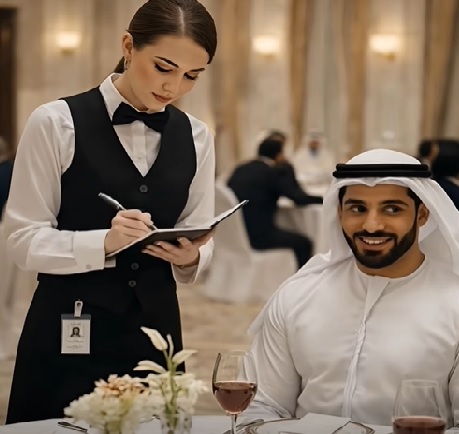
He spoke quietly, but loud enough for his companions to hear. The words were insulting—sharp, degrading. The kind of thing people say when they’re certain the other person won’t understand.
The table laughed again.
The waiter finished writing. A brief pause. He slightly tilted his head, as if making sure nothing was missed.
Then he looked up.
And replied.
In flawless Arabic.
“Sometimes silence is not a sign of ignorance,” he said calmly. “It is a choice—not to lower yourself to the level of the one who speaks.”
The room froze.
The laughter died instantly. One guest straightened in his seat. Another lowered his glass before it reached his lips.
For a moment, the sheikh didn’t even react. His expression stiffened, as if his mind refused to process what had just happened. He had expected fear. Embarrassment. Maybe submission.
But not this.
Not a precise, controlled response—delivered without anger, yet powerful enough to shatter the atmosphere he had created.
“You… understand Arabic?” he finally asked, his voice no longer steady.
The waiter allowed himself a small, calm smile.
“I understand much more than you assume,” he replied. “The real question is—what is worth listening to.”
The silence became heavy.
The guests who had laughed moments ago now avoided eye contact. Their confidence, their arrogance—it all vanished in seconds.
The sheikh tried to regain control.
“You’re forgetting who you’re talking to,” he said coldly.
But his voice had lost its edge.
The waiter didn’t step back.
“No,” he said evenly. “I know exactly who I’m speaking to. And that is precisely why I choose respect—even when it isn’t shown to me.”
The words landed harder than any insult.
Because there was no aggression in them. No fear. Only truth.
And that truth left the sheikh with nothing to say.
He opened his mouth, as if to respond… then stopped.
For the first time that evening, he had no words.
The waiter gently closed his notepad.
“Your order will be ready shortly,” he said, as if nothing had happened.
And walked away.
No rush. No unnecessary gestures. Just quiet strength—the kind that cannot be bought or displayed.
Gradually, the restaurant returned to life. Music resumed. Conversations picked up in hushed tones.
But something had changed.
Because everyone who witnessed that moment understood one simple truth:
real power isn’t in a loud voice, wealth, or status.
It’s in the ability to keep your dignity when someone tries to take it away.
And that, more than anything else, turned the entire evening upside down.